Textbook and manual
Complete and authoritative
Organised chapter by chapter and meant to be worked through. An everyday question can take a long time to answer.
One body of knowledge. Many ways in.
You know a skill. But where does it fit? Marcus’Mind connects knowledge from Dialectical Behavior Therapy: from your situation to a concept, from an explanation to a next step.


For anyone who wants to understand DBT from their own experience, and for professionals who work with it.
From everyday life to understanding.
Then one step further.
For you
You don’t need to know the technical term. Open whatever fits. The switches show how the app’s profiles give the same content a different emphasis. You can change your profile in the app menu at any time; all content remains accessible in every profile.
Profile “Under stress”
A term from your group or your last session comes back to you, but not what belongs to it. In the “Under stress” profile, the explanation comes first and supporting sections stay collapsed. You read only what you need right now.
Profile “For learning”
You want to understand why a skill is built the way it is and what it connects to. The “For learning” profile expands application, learning paths and connections.
Profile “Under stress”
When your head is full, a textbook doesn’t help. In the “Under stress” profile, Marcus’Mind offers fewer choices and puts situations and first steps in the foreground. You start with a description that fits you, not with a technical term.
Marcus’Mind is a knowledge app, not crisis support. In immediate danger, call your local emergency number; in Germany and the EU, that is 112.
Profile “For learning”
DEAR MAN, GIVE and FAST, or validation and radical acceptance: some skills sound alike yet serve a different goal. Comparisons put them side by side, and guiding questions lead to the right one.
Profile “For professionals”
Explaining a difference takes criteria, not just definitions. The “For professionals” profile expands comparisons, connections and detailed sources.
Profile “For learning”
Four modules, many skills, and connections between them that a book spreads across chapters. Marcus’Mind starts with the foundations and shows how topic groups and modules relate.
Profile “For professionals”
For training, teaching or getting started with skills training: Marcus’Mind makes the system behind the terms visible, with source notes alongside the content.
Profile “Under stress”
Sometimes it is enough to read the steps of an exercise once more. The guides describe step by step what you do and why.
Profile “For learning”
What is an exercise for, and how does it relate to the skill? 33 exercises and protocols include a step-by-step section, embedded in explanation and context.
Want to practise with your own situations and your own words? That is what the sister app Marcus’Mend is for: there you apply skills step by step to your own situation and work out the right words. Marcus’Mind explains, Marcus’Mend practises.
Profile “For professionals”
Explaining a term clearly, distinguishing two skills, putting together material for a group: Marcus’Mind offers a source-based foundation for this. Which content suits a person remains a professional judgement.
Profile “For learning”
In training, or taking part in a skills group? Use the modules and comparisons to prepare the topics of the next session.
How it works
From what brings you here to an explanation, from the explanation to the connections, and back to what you want to remember.
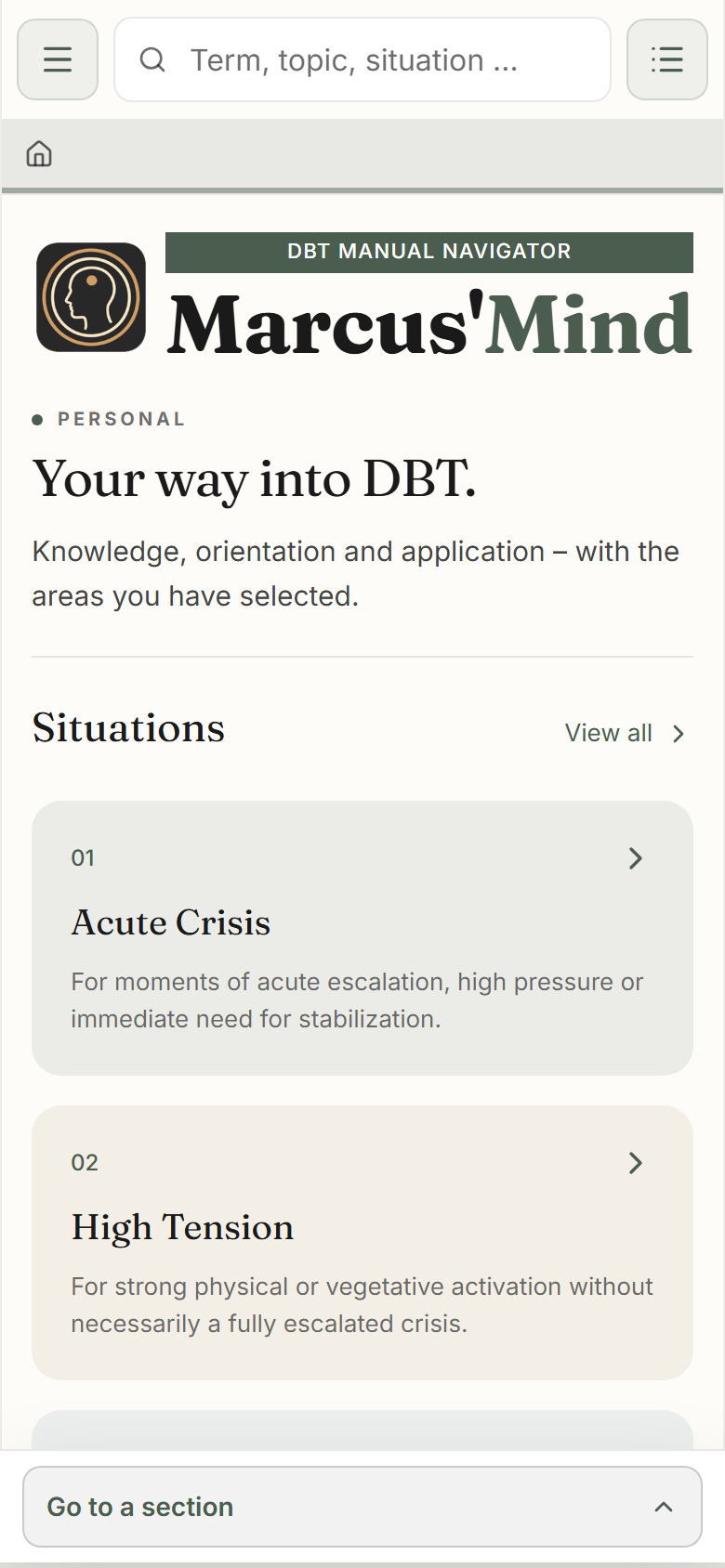
Choose a description from everyday life or search for a term. No specialist knowledge needed.
Every content page starts with the full explanation, whatever your profile.
Components, comparisons and next steps show how one piece of content relates to others.
Save content as bookmarks or in lists of your own and open them from the header.
Screens from the current app version. Select an image to enlarge it.
Inside Marcus’Mind
Choose an area. Each one shows what you will find in the app and what it is meant for.
You open a skill and want more than a definition: what is it for, when does it matter, what belongs to it? A content page brings these perspectives together. Which sections are expanded depends on the content and your profile.
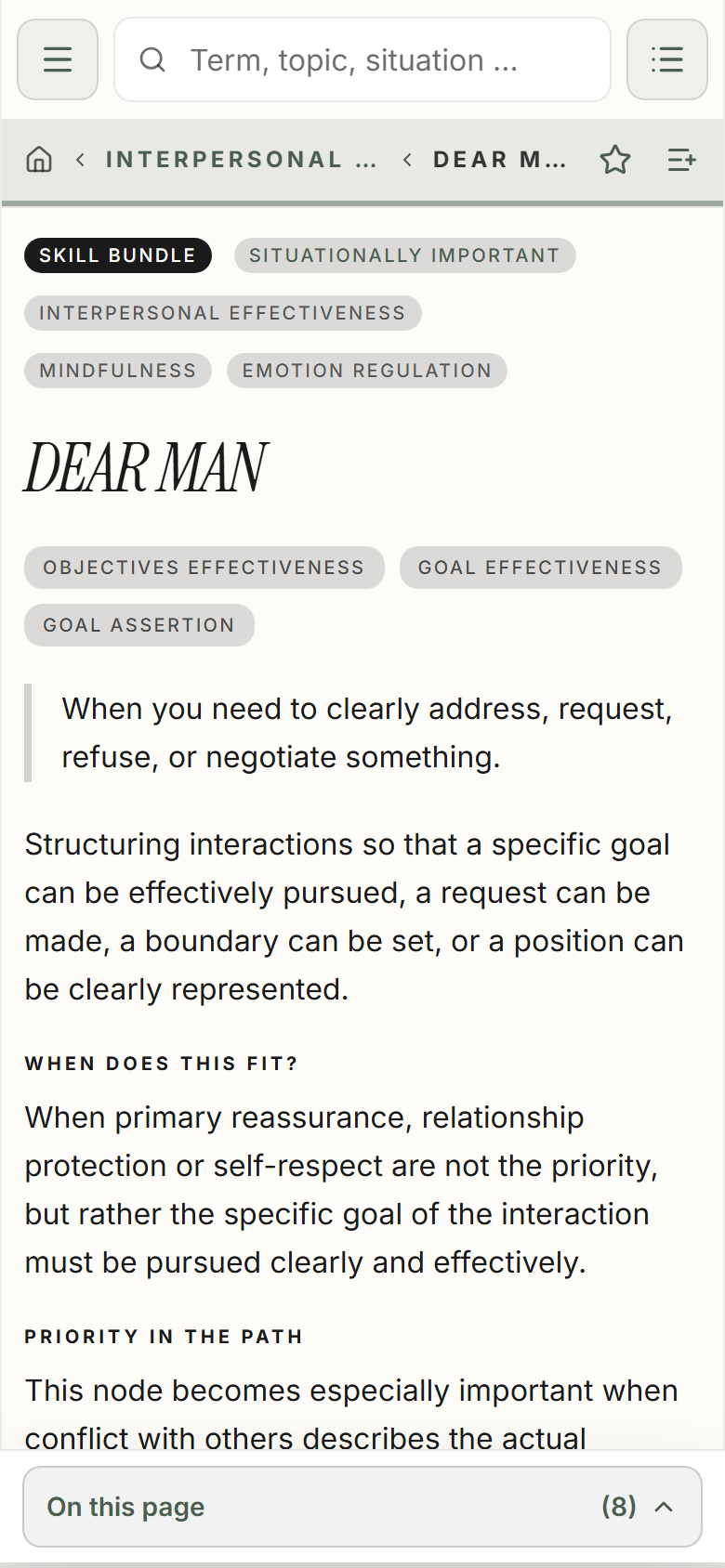
A skill bundle brings several skills together. Marcus’Mind makes each component accessible on its own: from the overview to one step and back. An acronym becomes a structure you can understand and find again. Example DEAR MAN, skills for communicating an objective:
Describe the situation factually.
Express feelings and your perspective.
State a request, boundary or position clearly.
Explain the benefits or possible positive consequences.
Stay focused on the objective.
Present yourself confidently.
Explore possibilities for agreement.
A brief look. In the app, DEAR MAN is also compared with GIVE and FAST: objectives, relationships and self-respect as different priorities.
503 professional connections link the content: components, links to exercises, related concepts and bridges between modules. You move from one piece of content to the next without searching.
33 exercises and protocols include a separate step-by-step section: what you do, in which order and why. The guides are knowledge to read, not a practice space.
Practise with your own situations and your own words: that is what the sister app Marcus’Mend is for. There you apply skills step by step to your own situation.
Save what you want to find again directly on the content. Read your lists from the header and manage them in the settings.
Your profile sets your starting point and which supporting sections are already expanded. All content remains accessible in every profile.
Change your profile in the menu at any time. The three preset profiles have fixed settings.
The format
DBT knowledge lives in manuals, worksheets and handouts. Marcus’Mind makes visible what is spread across many pages there.
Textbook and manual
Organised chapter by chapter and meant to be worked through. An everyday question can take a long time to answer.
Handout and skills list
Each card stands on its own. How it connects to others is found elsewhere, or not at all.
Marcus’Mind
503 professional connections between situations, skills and concepts, with source notes on each page. Marcus’Mind opens up the books; it does not replace them.
For professionals
Marcus’Mind supports psychoeducation, skills groups and training. Free and with no account, so there is no barrier for your clients.
Full explanations of skills, principles and frameworks, together in a session or to read afterwards.
18 comparisons and the guiding questions make differences traceable, for example between DEAR MAN, GIVE and FAST.
Collect content in lists of your own. Every content page has a permanent address you can pass on.
Marcus’Mind runs as a web app in the browser and as an Android app. On a computer the web app uses the width: on content pages the explanation and its parts sit side by side. That helps when preparing a session or group.
Marcus’Mind is a knowledge and orientation resource and does not give treatment recommendations. Suggested next steps and module links are orientation, not individual recommendations. The app is not clinically validated; the independently written guides have not been externally reviewed. Which content suits a person remains your professional judgement.
No account, no analytics, no ads. Bookmarks and lists stay on the device. Visiting the website involves technical connection data only.
Expands comparisons, connections and detailed sources. All content remains accessible in the other profiles too.
Every content page, comparison and guiding question has its own address. In the web app, copy the link from the address bar; there is no separate share function.
The literature behind the app
Marcus’Mind makes existing DBT knowledge accessible through its own navigation structure. The source overview distinguishes foundational texts, practical materials and supplementary professional literature. It explains where content comes from and helps you continue reading in the original works.
Foundations
The manual provides the foundation for the module structure, skills and their context.
Practical materials
The companion workbook adds materials for skills training to the explanations in the manual.
Application
This practice-oriented workbook supplements the source base with exercise sequences and everyday applications.
Further reading
Supplementary German-language professional literature on DBT-oriented, transdiagnostic concepts and skills training.
Marcus’Mind writes all explanations itself and does not reproduce text from the books; they are sources for further reading. It is not an official app of the named authors, and its basis in the literature does not establish that the app is effective.
Your knowledge. Your device.
Bookmarks, personal lists and settings are stored locally. There is no user account or proprietary cloud sync. This website does not read your app data.
Bookmarks, personal lists and settings are stored on your device or in your browser. There is no sync.
No email address, no password, no registration. Open the app and start.
Neither the app nor this website includes analytics or advertising services.
When you open the website or the web app, the hosting providers process technical connection data. Messages sent through the contact form are delivered by a form service.
When you need more than knowledge
The app includes an editorial directory of 176 DBT services in Germany, Austria and Switzerland, selectable by federal state and country.
The directory is for orientation and is not a treatment recommendation. It is available in German.
 USER GUIDEFind knowledge.
User guide · English
From opening the app to building your own list: the guide explains the current interface with screenshots, practical instructions and common questions.
English · With contents and app screenshots
The Marcus family
Notice feelings, understand connections and practise skills. The three sister apps have different strengths and can be used independently.
Feelings & patterns

Name feelings precisely, discover skills and recognise your own patterns over time.
Knowledge & orientation
Understand DBT, explore connections and return to useful content.
Practice & application

Practise skills in your own situations and work towards your own words, step by step.
Independent apps. Bookmarks, entries and drafts are not automatically transferred between them.
Behind the app
Marcus’Mind is not made by an institution but by one person, the same person who develops Marcus’Mood and Marcus’Mend. There is plenty of DBT knowledge, but it rarely shows how things fit together. That is what Marcus’Mind sets out to change: carefully, with sources, free of charge. If the app helps you, I would appreciate a review on Google Play. If something is missing or wrong, let me know.
DBT stands for Dialectical Behavior Therapy. Marcus’Mind helps you explore its concepts and skills. Start with the foundations or look something up directly.
No. You can start with a situation from everyday life or with the foundations. If you know DBT, you will find comparisons, connections and sources to go deeper.
Marcus’Mind is free to use, with no subscription, registration or ads. Start in your browser or open the Android app on Google Play.
Yes, Marcus’Mind is built for understanding: explanations, connections and steps to read. To practise with your own situations there is Marcus’Mend; for feelings and how they change over time, Marcus’Mood.
A book takes you through DBT chapter by chapter. Marcus’Mind shows how content connects and helps you quickly find what you are looking for. It does not replace the books; it points to them.
The content is based on the DBT literature by Marsha M. Linehan, the workbook by McKay, Wood and Brantley and the book edited by Martina Sutor. All texts are written independently; nothing is reproduced from the books. Marcus’Mind is developed by a private individual who also develops Marcus’Mood and Marcus’Mend. It is not an official app of the authors.
Yes. Marcus’Mind is also available as an Android app on Google Play. You can use the web app in a browser and add it to your home screen where supported.
German, English, Spanish and French. DBT names such as DEAR MAN or TIP stay in their original form. The therapy directory is currently available in German only.
The Android app includes its app files. The web app caches files for offline access; availability depends on what has already been loaded and retained in your browser. External links need an internet connection. Check the content you need in flight mode beforehand.
Yes. Every content page has a permanent address. In the web app, copy the link from the address bar; there is no separate share function. Anyone opening the link needs no account.
Exercise pages explain the process and do not include fillable forms. Use paper or your own document for notes. Marcus’Mend offers a separate practice space for developing your own wording.
On your device or in this browser. There is no automatic sync. Clearing website data or app storage may also remove this information.
No. Marcus’Mind provides knowledge and orientation. It does not replace diagnosis, therapy or crisis care. In immediate danger, contact your local emergency number; in Germany and the EU, call 112.
How to start
Open Marcus’Mind and start wherever you are.
A knowledge and orientation resource, not crisis support. In immediate danger, call your local emergency number (112 in Germany and the EU).